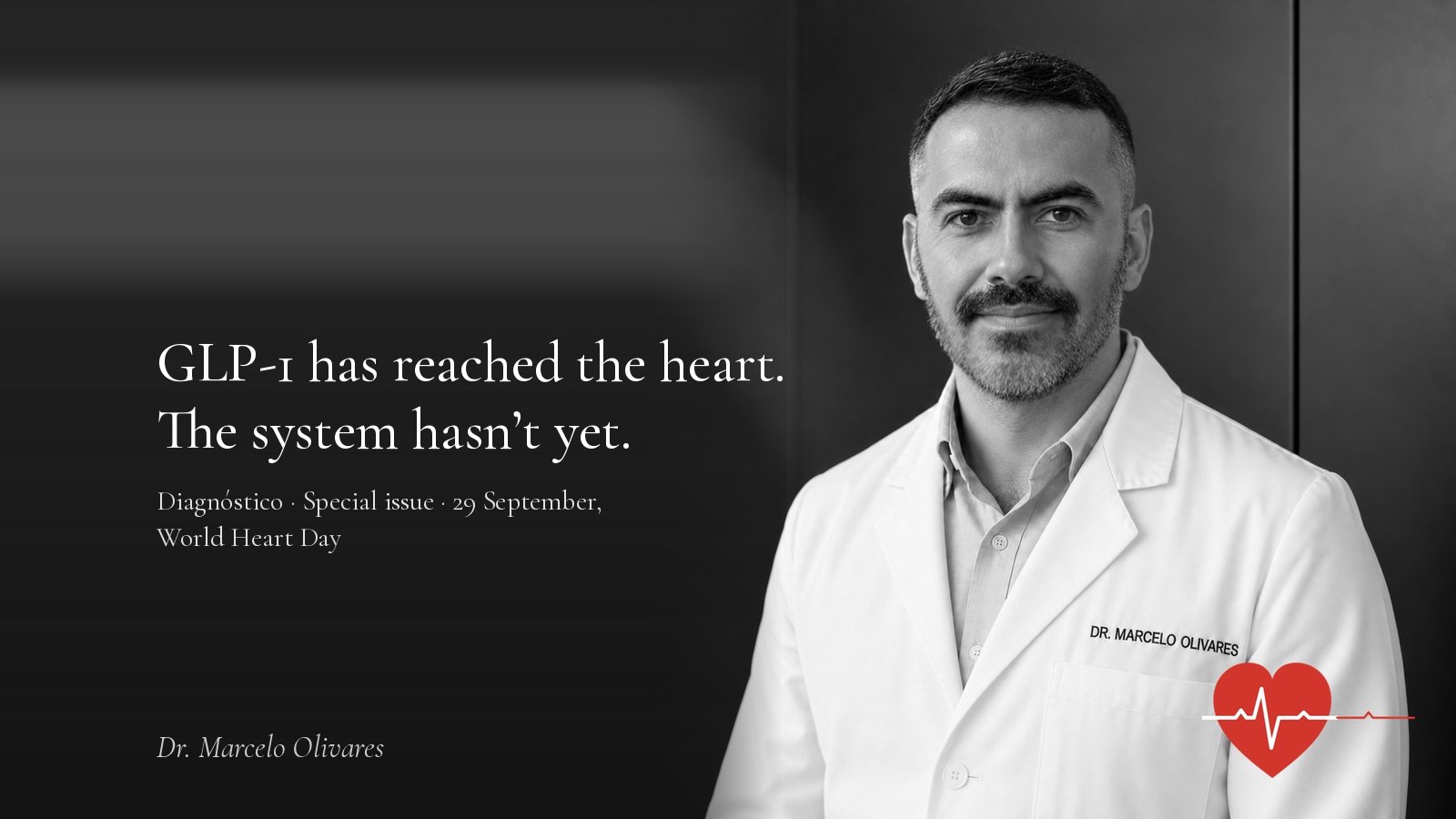
GLP-1 has reached the heart. The system hasn’t yet.
Every September 29 the world looks to the heart, and rightly so: cardiovascular disease claims more than 20 million lives a year and, according to the World Heart Federation, 80% of those deaths are explained by risk factors that can be prevented or controlled. In Chile the figure has a name of its own… in 2024 diseases of the circulatory system caused 32,011 deaths, that is, they remain the country’s leading cause of death, just ahead of cancer.
Into that scenario came a family of drugs that a decade ago we associated only with diabetes and that today is discussed in consulting rooms, boardrooms and around the dinner table: GLP-1 receptor agonists. The SELECT trial followed 17,604 people with established cardiovascular disease, overweight or obesity and no diabetes, and showed that semaglutide produced a 20% relative risk reduction in a composite outcome, that is, cardiovascular death, non-fatal heart attack or non-fatal stroke taken together, not each event separately. SURPASS-CVOT, published in December 2025, compared tirzepatide, a dual GIP and GLP-1 receptor agonist, with dulaglutide, a GLP-1 with proven cardiovascular benefit, in people with type 2 diabetes and cardiovascular disease, and showed it was non-inferior on that outcome, with greater weight loss.
There is one finding I find more interesting than the headline. A mediation analysis of SELECT published this year tried to estimate how much of the cardiovascular benefit runs through known risk factors: waist circumference and inflammation appear as possible mediators, weight alone with a smaller role, but the estimates carry substantial uncertainty and do not allow a precise split between what is explained and what remains open. In other words, it would be premature to reduce these drugs to “losing weight”. They are something we are still coming to understand.
And here lies the trap. When a molecule works, the temptation is to think the problem is solved.
It isn’t, for three reasons. The first is Access: the WHO, in its first guideline on GLP-1 medicines for obesity, estimated that even with a rapid expansion of production they will reach fewer than 10% of those who could benefit by 2030. The second is Adherence: in SELECT, 16.6% of participants treated with semaglutide permanently discontinued treatment because of adverse events, compared with 8.2% in the placebo group. The third is Design: the WHO itself recommends pairing the drug with nutrition and physical-activity interventions, because the medicine performs better within a program than as an isolated response.
For you, the conclusion is concrete: if you live with cardiovascular disease, obesity or diabetes, the conversation about these treatments is legitimate and belongs with your doctor, alongside blood pressure, cholesterol, tobacco and movement, which remain the foundation.
For a clinic, an insurer or a company, the question is different: not whether to cover a drug, but whom to select, how to support them and how to measure that the benefit reaches the heart and not just the scale. That is how Cardiovascular Health stops being a one-day campaign and becomes a Program.
The drug is a tool. Prevention is still a system decision.
Sources: World Heart Federation, Don't Miss a Beat 2026 · DEIS-MINSAL, 2024 deaths (via GesNova Salud) · Lincoff AM, et al. SELECT. N Engl J Med 2023 · Nicholls SJ, et al. SURPASS-CVOT. N Engl J Med 2025 · Colhoun HM, et al. Mediation in SELECT. Eur Heart J 2026 · WHO, guideline on GLP-1 medicines for obesity, 2025
Correction: an earlier version stated that one in ten participants stopped treatment because of adverse events. The corresponding figure in SELECT is 16.6% with semaglutide, compared with 8.2% with placebo.