Same active ingredient,
broader access possible.
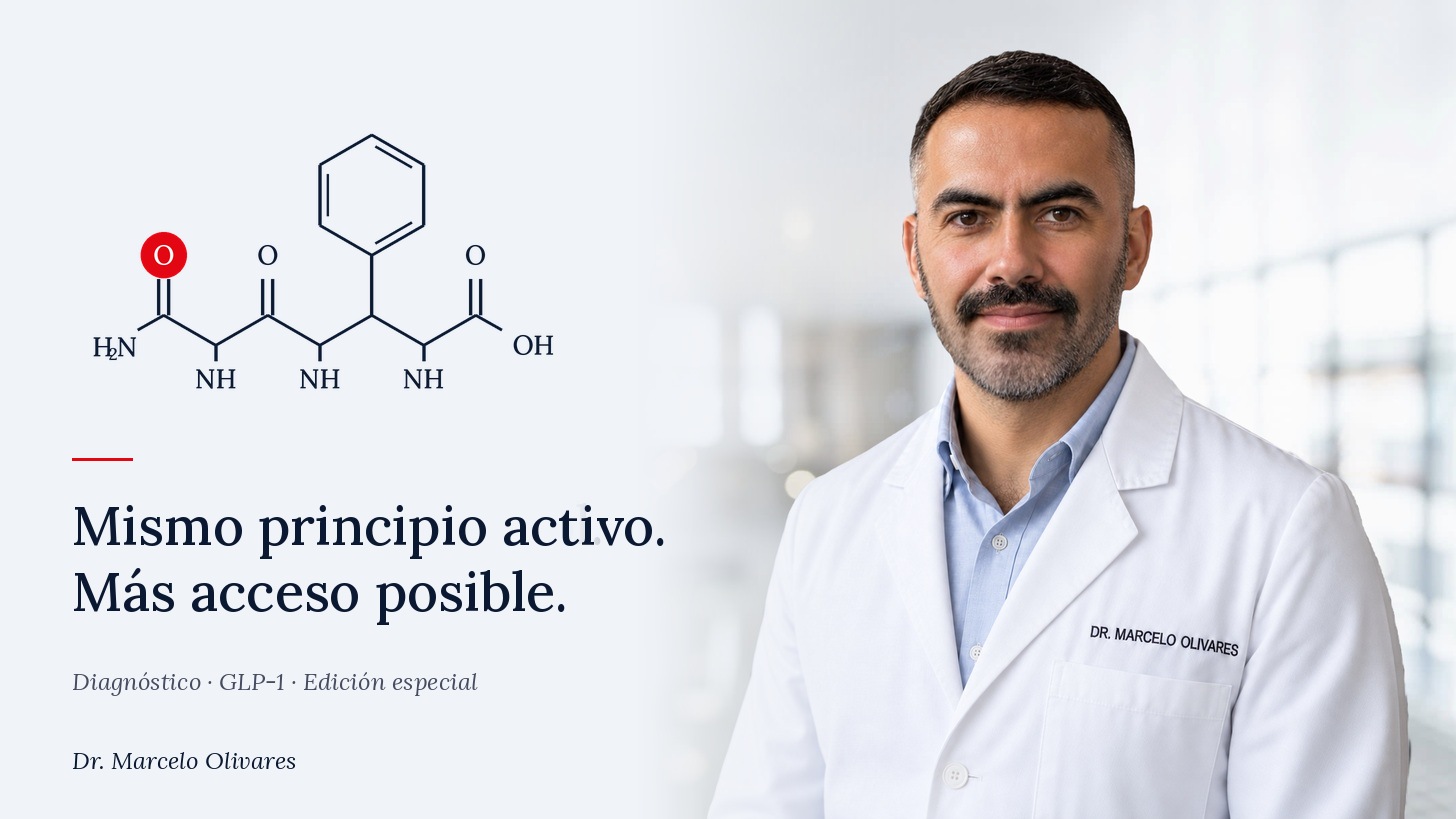
On 20 October, Chile’s Public Health Institute (ISP) approved Picmagluti, from Dr. Reddy's Laboratories Chile, the first chemically synthesised semaglutide registered in the country (a GLP-1 receptor agonist), with two marketing authorisations covering the 0.25 or 0.5 mg and the 1 mg doses. Ozempic, by contrast, is registered in Chile as a biological product. In other words, the same active ingredient arrives by a different manufacturing route, and the ISP made clear that this route does not qualify for a simplified registration: it went through the ordinary assessment.
A molecule is not a system. And this news tests it on three dimensions: access, quality and follow-up.
Access is the first, and above all the one that matters most. Until now, cost has been the barrier for many people, and a synthetic alternative can widen that access, especially if the price falls: Diario Financiero anticipates a price below half that of Ozempic. That is an expectation, not a fact. There is no official price or date of arrival in pharmacies, and approval is not availability. Canada and Brazil took the same step in May 2026, Argentina in 2024, and eleven more applications from four laboratories are pending at the ISP. Competition, in other words, will do much of the work… if regulation holds the standard.
Quality is the second. In chemical synthesis the impurity profile is the critical variable, and registration exists to demand that evidence. The cardiovascular outcomes that made semaglutide famous come from the original product, so they do not transfer automatically to a copy: they are confirmed or monitored.
Follow-up is the third. More people with access requires teams to accompany them: gradual titration, protein and strength training to protect muscle mass, adherence, and clarity about what happens on stopping. A more accessible drug without a clinical programme behind it is, simply, a more accessible drug.
For clinics, insurers and employers, the decision in the coming weeks is not whether to include a molecule, but who prescribes it, how the outcome is measured and when it is withdrawn.
The molecule has been approved. The system hasn’t, yet.
Sources: ISP, press release, 20-10-2026 · BioBioChile, 20-10-2026 · La Tercera, 21-10-2026 · Saludaldía. This issue describes a regulatory development and is not individual medical advice.